Inhaltsverzeichnis
- Was bedeutet Code 40, Code 55 und Code 80?
- Wie hoch sind die Schienenprofile wirklich?
- Wie hoch sind Schienen beim Vorbild?
- Was wäre bei Spur N maßstäblich?
- Warum Modellbahnschienen nicht nur nach dem Maßstab konstruiert werden
- Warum niedrigere Schienenprofile anspruchsvoller sein können
- Spurkränze und niedrige Schienenprofile
- Warum Weichen zum entscheidenden Praxistest werden können
- Warum Code 80 weiterhin seine Berechtigung hat
- Kann Code 80 trotzdem gut aussehen?
- Code 55 als Mittelweg
- PECO Code 55 ist ein Sonderfall
- Code 55 ist nicht automatisch gleich Code 55
- Wie weit kann man mit Code 40 gehen?
- Code 55 und Code 80 miteinander verbinden
- Welches Schienenprofil passt zu meiner Anlage?
- Quellen
Bei der Frage nach Code 55 oder Code 80 in Spur N geht es nicht nur um Optik. Die Profilhöhe ist ein Teil eines ganzen Gleis-Rad-Systems. Schienenprofil, Schwellen, Kleineisen, Spurweite, Radprofil, Spurkranzhöhe, Radsatzmaße, Radlenker, Herzstück, Weichengeometrie, Gleislage und Übergänge wirken zusammen. Deshalb ist ein niedrigeres Profil nicht automatisch die bessere Wahl. Ein höheres Profil ist ebenso wenig automatisch technisch überholt.
Die sinnvolle Wahl ist ein Kompromiss aus Vorbildnähe, Fahrzeugkompatibilität, dem konkreten Gleissystem, sauberer Gleislage und der gewünschten Betriebssicherheit. Gerade bei einem vorhandenen Fahrzeugbestand lohnt es sich, nicht nur den Code auf der Verpackung zu vergleichen.
Was bedeutet Code 40, Code 55 und Code 80?
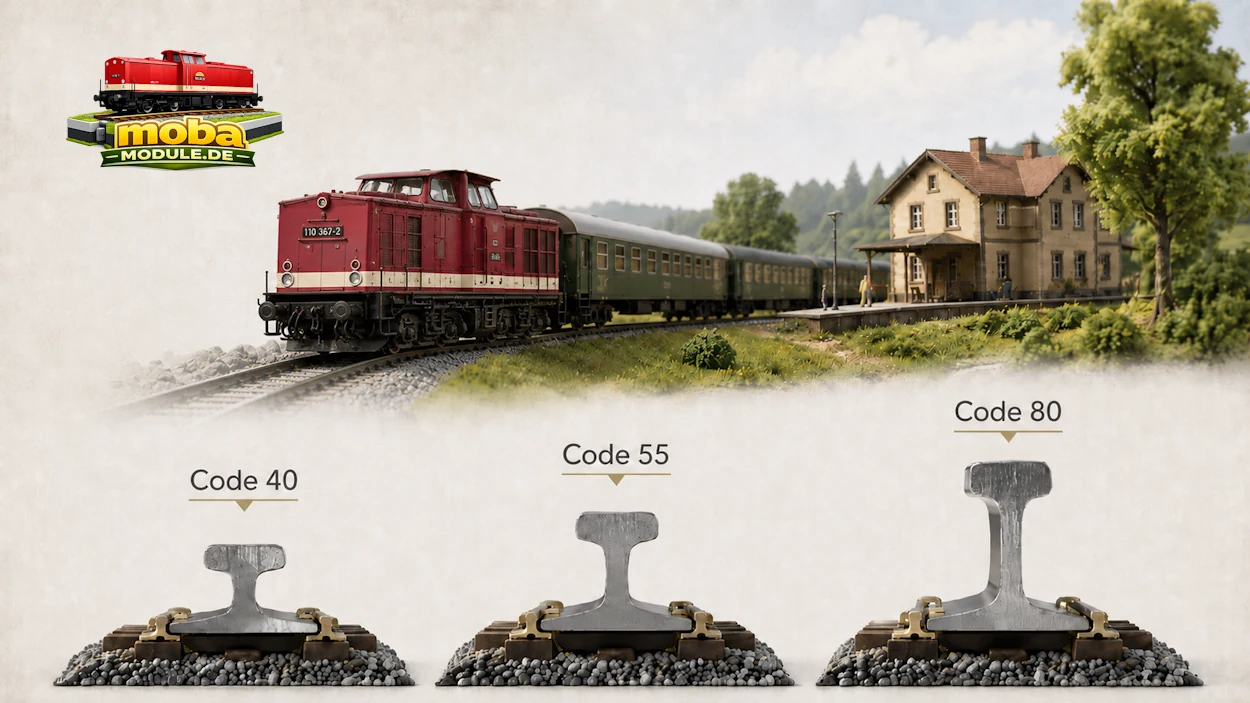
Die NMRA erklärt im Beginners Guide, dass „Code“ die Höhe der Metallschiene in Tausendstel Zoll bezeichnet. Gemeint ist nur die Schiene selbst. Die Gesamthöhe aus Schiene, Schwellen und gegebenenfalls Bettung gehört nicht zur Code-Angabe.
Die Umrechnung ist eindeutig. Ein internationaler Zoll entspricht nach NIST exakt 25,4 mm. Damit ergeben sich für Code 40 genau 1,016 mm, für Code 55 genau 1,397 mm und für Code 80 genau 2,032 mm nominelle Schienenhöhe.
Wie hoch sind die Schienenprofile wirklich?
Code 40 ist rund 1,02 mm hoch. Code 55 liegt bei rund 1,40 mm und Code 80 bei rund 2,03 mm. Die NMRA Recommended Practice RP-15.1 führt Code 40 und Code 55 mit nominalen Zollmaßen auf.
| Modell oder Vorbild | Höhe im Modell bei 1:160 | Auf 1:160 hochgerechnet oder reale Vorbildhöhe |
|---|---|---|
| Code 40 | 1,016 mm | 162,6 mm hochgerechnet |
| Code 55 | 1,397 mm | 223,5 mm hochgerechnet |
| Code 80 | 2,032 mm | 325,1 mm hochgerechnet |
| 49E1 | 0,931 mm bei 1:160 | 149 mm reale Profilhöhe |
| 54E1 | 0,994 mm bei 1:160 | 159 mm reale Profilhöhe |
| 60E1 | 1,075 mm bei 1:160 | 172 mm reale Profilhöhe |

Wie hoch sind Schienen beim Vorbild?
Für einen europäischen Vergleich lassen sich genormte Vollbahnprofile heranziehen. ArcelorMittal nennt für das nach EN 13674-1 gefertigte Profil 49E1 beziehungsweise S49 eine Höhe von 149 mm. Für 54E1 beziehungsweise UIC54 sind es 159 mm. Das Profil 60E1 beziehungsweise UIC60 ist 172 mm hoch.
Auf den hier verwendeten Spur-N-Maßstab 1:160 verkleinert wären das rund 0,93 mm, 0,99 mm und 1,08 mm. Diese Zahlen beschreiben ausschließlich die Profilhöhe. Kopfbreite, Fußbreite, Stegdicke, Ausrundungen, Schwellen und Befestigungen sind eigene geometrische Größen.
Was wäre bei Spur N maßstäblich?
Der reine Höhenvergleich liefert ein bemerkenswertes Ergebnis. Code 40 entspricht in 1:160 einer hochgerechneten Höhe von rund 162,6 mm. Damit liegt die reine Schienenhöhe zwischen den hier betrachteten Vorbildprofilen 54E1 mit 159 mm und 60E1 mit 172 mm. Code 40 ist deshalb aber nicht automatisch ein vollständig maßstäbliches Gleis. Der Vergleich sagt nur etwas über eine einzige Abmessung.
Code 55 entspricht hochgerechnet rund 223,5 mm und Code 80 rund 325,1 mm. Bezogen nur auf die Höhe liegen beide deutlich über den genannten Vollbahnprofilen. Daraus lässt sich keine vollständige Qualitätsbewertung eines Modellgleises ableiten. Die sichtbare Wirkung und die technische Funktion werden von weiteren Abmessungen bestimmt.
Warum Modellbahnschienen nicht nur nach dem Maßstab konstruiert werden
Modellgleis ist ein Funktionssystem. Die MOROP NEM 310 sagt ausdrücklich, dass die Radsatzmaße im Interesse der Betriebssicherheit von der maßstäblichen Verkleinerung des Vorbildes abweichen. Das ist ein wichtiger Grundsatz. Vorbildnähe ist ein Ziel, aber sie steht nicht allein.
Auch die Schiene selbst ist ein technischer Kompromiss. Die NMRA beschreibt in RP-15.1 für kleine Profile einen Ausgleich zwischen maßstäblicher Verkleinerung, mechanischer Festigkeit und ausreichendem Querschnitt für die Übertragung des Fahrstroms. Bei klassischen Zweischienensystemen ist die Schiene nicht nur Fahrweg, sondern zugleich Teil der elektrischen Versorgung.
Warum niedrigere Schienenprofile anspruchsvoller sein können
Ein niedrigerer Code verkleinert zunächst nur die nominelle Höhe der Metallschiene. Wie viel Platz ein Spurkranz tatsächlich über Schwellen und nachgebildeten Befestigungen hat, hängt vom konkreten Gleissystem ab. Genau deshalb ist „Code 55“ keine vollständige Aussage über die Fahrzeugkompatibilität.
In Praxisberichten werden Unterschiede zwischen Gleissystemen sichtbar. Nutzer von bestimmten Atlas-Code-55-Systemen berichten beispielsweise von tiefen Spurkränzen, die an nachgebildeten Befestigungen oder im Schwellenbereich anstoßen und ein Rattern verursachen können. Andere Anwender berichten über problemlosen Betrieb auf PECO Code 55. Solche Erfahrungen sind keine allgemeingültige Norm, zeigen aber, weshalb die konkrete Konstruktion wichtiger ist als die Code-Zahl allein.
Auch die Gleislage bleibt entscheidend. Die NMRA weist im Beginners Guide darauf hin, dass schlecht verlegtes Gleis und besonders problematische Weichen zu Entgleisungen führen können. Ein höheres Profil beseitigt keine Fehler in Gleislage, Übergängen oder Fahrzeugmechanik. Umgekehrt ist ein niedrigeres Profil nicht automatisch störanfällig, wenn Gleis und Fahrzeuge sauber zusammenpassen.
Spurkränze und niedrige Schienenprofile
Die MOROP NEM 311 ergänzt die Radsatznorm um das Radreifenprofil. Sie beschreibt ausdrücklich das Zusammenwirken von Radbreite, Spurkranz, Ausrundung und Gleisgeometrie. Für Weichen werden Rillenweite und Herzstückbereich wichtig. NEM 311 nennt außerdem die Ausrundung zwischen Lauffläche und Spurkranz als bedeutsam für die Laufsicherheit.
Damit wird klar, warum ein tiefer Spurkranz nicht isoliert betrachtet werden kann. Entscheidend ist, ob Radsatzmaße, Rillenweiten und die Geometrie des jeweiligen Gleises zusammenpassen. NEM 310 behandelt ausdrücklich unterschiedliche Spurkranzhöhen im Zusammenhang mit der Rillenweite am Herzstück. Eine pauschale Regel, nach der jeder hohe Spurkranz auf jeder Code-55-Schiene aufsetzt, wäre deshalb falsch.
Warum Weichen zum entscheidenden Praxistest werden können
Ein gerades Testgleis prüft nur einen Teil des Systems. NEM 310 und NEM 311 zeigen, dass im Herzstückbereich zusätzliche Maße ins Spiel kommen. Rillenweite, Radbreite, Leitmaß und Spurkranzgeometrie beeinflussen, wie ein Radsatz durch die Weiche geführt wird. Auch Radlenker, Zungenbereich und Kreuzungen stellen andere geometrische Bedingungen als ein gerades Stück Flexgleis.
Forenerfahrungen passen zu diesem technischen Bild. In einer Reddit-Diskussion aus Mai 2026 berichten mehrere Anwender über langjährigen problemlosen Betrieb mit Code 55. Ein anderer Nutzer beschreibt sein Atlas-Code-55-Gleis als empfindlicher bei Gefällewechseln, direkt aufeinanderfolgenden Weichen und Kreuzungen. Im Stummiforum werden ebenfalls unterschiedliche Erfahrungen mit NEM-Radsätzen auf verschiedenen Code-55-Weichen beschrieben.
Wer bereits viele Fahrzeuge besitzt und auf ein niedrigeres Profil wechseln möchte, sollte deshalb einen Testaufbau mit genau dem später vorgesehenen Gleissystem bauen. Sinnvoll ist nicht nur gerades Gleis. Mindestens eine tatsächlich geplante Weichenbauart sollte enthalten sein. Besonders aufschlussreich sind die ältesten Lokomotiven und Wagen sowie Fahrzeuge mit auffällig hohen Spurkränzen oder bereits bekanntem empfindlichem Lauf.
Warum Code 80 weiterhin seine Berechtigung hat
Die reine Profilhöhe von Code 80 ist in Spur N gegenüber den genannten Vollbahnprofilen deutlich übermaßstäblich. Das ist mathematisch eindeutig. Daraus folgt aber nicht, dass Code 80 technisch schlecht oder für heutige Anlagen ungeeignet wäre.
In mehreren Spur-N-Foren berichten Modellbahner, dass sie Code 80 bewusst wegen eines älteren oder gemischten Fahrzeugbestands wählen. Im NScale.net-Thread zu Code 80 und Code 55 wird die mögliche Relevanz größerer Spurkränze bei älterem Material ausdrücklich angesprochen. In einer weiteren NScale.net-Diskussion werden dagegen Unterschiede zwischen konkreten Code-55-Systemen hervorgehoben. Das sind Anwendererfahrungen und keine allgemeine Garantie für Betriebssicherheit.
Code 80 ist deshalb vor allem dann eine nachvollziehbare Option, wenn vorhandenes Material erhalten bleiben soll und breite Kompatibilität im eigenen Fahrzeugpark wichtiger ist als eine möglichst niedrige sichtbare Profilhöhe. Auch hier bleibt der Test mit den tatsächlich verwendeten Weichen und Fahrzeugen aussagekräftiger als die Code-Zahl allein.
Kann Code 80 trotzdem gut aussehen?
Geometrische Vorbildnähe und optische Gesamtwirkung sind zwei verschiedene Dinge. Die Profilhöhe ist messbar. Wie ein fertig gestaltetes Gleis wahrgenommen wird, hängt zusätzlich von Schienenflanken, Schwellen, Schotterbett und Einbindung in die Landschaft ab.
In NScale.net-Erfahrungsberichten beschreiben Modellbahner, dass lackiertes und eingeschottertes Code-80-Gleis deutlich feiner wirken kann als unbehandeltes Material. Solche Aussagen sind gestalterische Erfahrungen.
Für die praktische Gestaltung ist der vorhandene MOBA-Module-Beitrag „Modelleisenbahn Modul #01 Spur N – Gleise und schottern Teil 2“ thematisch passend. Er zeigt den Gleisbau im Zusammenhang mit dem Schotterbett, also genau den Bereich, der die spätere Gesamtwirkung mitbestimmt.
Code 55 als Mittelweg
Code 55 reduziert die nominelle Schienenhöhe gegenüber Code 80 deutlich. Die NMRA nennt Code 55 im Beginners Guide für Spur N als realistischere Profilgröße, die weiterhin gut verwendbar ist. Das macht Code 55 zu einer interessanten Option, aber nicht automatisch zum besten Kompromiss für jede Anlage.
Wer überwiegend aktuelles Fahrzeugmaterial besitzt, Wert auf eine feinere sichtbare Profilhöhe legt und das geplante Gleissystem vorher testet, kann mit Code 55 sehr gut arbeiten. Bei älteren Fahrzeugen entscheidet die konkrete Kombination aus Radsatz und Gleissystem.
PECO Code 55 ist ein Sonderfall
PECO beschreibt sein Streamline N Gauge Code 55 als spezielles Profil mit nur 1,4 mm sichtbarer Schienenhöhe. Nach Herstellerangabe verbindet diese Profilkonstruktion die niedrige sichtbare Höhe mit Festigkeit und Dauerhaftigkeit. PECO gibt außerdem an, dass dieselben Universal-Schienenverbinder wie beim eigenen Code-80-System verwendet werden.
PECO wirbt für dieses System mit breiter Fahrzeugkompatibilität. Das ist eine Herstellerangabe und keine unabhängige Garantie für jedes jemals produzierte Spur-N-Fahrzeug. Bei sehr altem oder ungewöhnlichem Material bleibt ein eigener Test sinnvoll.
Code 55 ist nicht automatisch gleich Code 55
Die Code-Angabe beschreibt zunächst nur die nominelle Höhe der Schiene. Sie legt weder Schwellengeometrie noch Kleineisen, Weichenkonstruktion, Herzstück, Profilquerschnitt oder gesamte Gleishöhe fest. Zwei Code-55-Produkte verschiedener Hersteller können sich deshalb im praktischen Betrieb unterschiedlich verhalten.
Gerade für die Frage nach dem Spurkranz ist der freie Raum über Schwellen und Befestigungsdetails entscheidend. Nutzerberichte zu Atlas und PECO zeigen unterschiedliche Erfahrungen. Daraus sollte keine Hersteller-Rangliste entstehen. Die sachliche Konsequenz lautet nur, dass der konkrete Systemaufbau geprüft werden muss.
Wie weit kann man mit Code 40 gehen?
Code 40 ist in Spur N besonders interessant, weil die nominelle Höhe von 1,016 mm bei 1:160 rund 162,6 mm entspricht. Bezogen allein auf die Schienenhöhe liegt das erstaunlich nah an realen Vollbahnprofilen wie 54E1 mit 159 mm und 60E1 mit 172 mm.
Die NMRA führt Code 40 als reguläre Profilgröße in RP-15.1 und weist im Beginners Guide darauf hin, dass noch kleinere Profile verfügbar sind, bei weniger fertigen Komponenten aber mehr Können verlangen. Code 40 ist daher kein Synonym für unzuverlässigen Betrieb. Es bedeutet vielmehr, dass die Abstimmung von Radprofil, Spurkranz, Weichen und Gleislage sorgfältig geprüft werden sollte. Ein fachgerecht aufgebautes System mit passenden Fahrzeugen kann zuverlässig funktionieren.
Code 55 und Code 80 miteinander verbinden
Beim Übergang zwischen unterschiedlichen Profilhöhen muss die Lauffläche der Schienenköpfe sauber auf eine Höhe gebracht werden. Wie das geschieht, hängt vom konkreten Gleissystem ab. Möglich sind herstellerspezifische Übergangsverbinder, Übergangsgleise, Unterfütterungen oder andere vorgesehene Lösungen.
Für PECO gibt es eine konkrete Herstellerangabe. Das PECO Setrack N Gauge Code 80 wird als vollständig kompatibel mit PECO Code 80 Streamline und PECO Code 55 Streamline beschrieben. Diese Aussage gilt für die genannten PECO-Systeme.
Welches Schienenprofil passt zu meiner Anlage?
Eine pauschale Siegerempfehlung wäre fachlich zu einfach. Code 80 kann für Anlagen mit großem älterem oder gemischtem Fahrzeugbestand interessant sein, wenn die Kompatibilität mit dem eigenen Material im Vordergrund steht oder bereits viel Code-80-Material vorhanden ist. Dass einige Modellbahner genau aus diesen Gründen Code 80 wählen, ist durch die genannten Erfahrungsberichte belegt.
Code 55 ist interessant, wenn eine niedrigere sichtbare Profilhöhe gewünscht wird und das gewählte Gleissystem zum Fahrzeugbestand passt. Bei überwiegend aktuellem Material und einem vorher getesteten System kann es Vorbildwirkung und zuverlässigen Betrieb gut verbinden. Die Aussage gilt für das abgestimmte Gesamtsystem und nicht für jede beliebige Kombination.
Code 40 richtet sich an Modellbahner, denen die maßstäbliche Profilhöhe besonders wichtig ist und die bereit sind, Gleisbau und Fahrzeugkompatibilität genauer aufeinander abzustimmen. Die Nähe zur Vorbildhöhe ist ein starkes geometrisches Argument. Sie ist aber kein Qualitätsurteil über das gesamte Gleis.
Der wichtigste Praxistipp bleibt deshalb einfach. Vor einer kompletten Anlage einen Testabschnitt mit genau dem geplanten Gleissystem bauen. Nicht nur gerades Flexgleis verwenden, sondern mindestens eine vorgesehene Weichenbauart einbeziehen. Dann die ältesten Lokomotiven, die ältesten Wagen, Fahrzeuge mit auffällig hohen Spurkränzen und bereits bekannte Problemkandidaten gezielt prüfen.
Die Frage Code 55 oder Code 80 Spur N lässt sich nicht mit „niedriger ist besser“ beantworten. Code 40 liegt bei der reinen Profilhöhe erstaunlich nah an mehreren realen Vollbahnprofilen. Code 55 reduziert die nominelle Profilhöhe deutlich gegenüber Code 80. Code 80 bleibt für manche Anlagen mit älterem oder gemischtem Fahrzeugbestand eine bewusst gewählte und technisch nachvollziehbare Option.
Entscheidend ist das Zusammenspiel von Schiene, Schwellen, Befestigungen, Radprofil, Spurkranz, Radsatzmaßen, Weichen und Gleislage. Wer diese Komponenten zusammen betrachtet und den eigenen Fahrzeugbestand auf dem tatsächlich geplanten Gleissystem testet, trifft die belastbarere Entscheidung als mit der Code-Zahl allein.
Quellen
Primärquellen und technische Normen
- NMRA, Beginners Guide Part 4, Laying Track
- NMRA, Recommended Practice RP-15.1 Rail
- MOROP, NEM 310 Radsätze, Spurführungs-Maße
- MOROP, NEM 311 Radreifenprofile
- NIST, SI Units – Length
- ArcelorMittal Rails, 49E1 (S49)
- ArcelorMittal Rails, 54E1 (UIC54)
- ArcelorMittal Rails, 60E1 (UIC60)
- PECO, Streamline N Gauge Code 55
- PECO, Setrack N Gauge Code 80
English version
When considering Code 55 or Code 80 in N scale, appearance is not the only factor. Rail height is one part of an entire wheel-and-track system. Rail profile, ties, rail fastenings, track gauge, wheel profile, flange height, wheelset dimensions, guard rails, frogs, turnout geometry, track alignment and transitions all interact. A lower profile is therefore not automatically the better choice. A higher profile is not automatically technically outdated either.
A sensible choice is a compromise between prototype fidelity, vehicle compatibility, the specific track system, accurate track laying and the desired operational reliability. With an existing fleet in particular, it is worth looking at more than just the code printed on the packaging.
What do Code 40, Code 55 and Code 80 mean?
The NMRA explains in its Beginners Guide that “Code” denotes the height of the metal rail in thousandths of an inch. Only the rail itself is meant. The overall height made up of rail, ties and, where applicable, roadbed is not part of the code designation.
The conversion is straightforward. According to NIST, one international inch is exactly 25.4 mm. This gives an exact nominal rail height of 1.016 mm for Code 40, 1.397 mm for Code 55 and 2.032 mm for Code 80.
How high are the rail profiles really?
Code 40 is about 1.02 mm high. Code 55 is about 1.40 mm and Code 80 about 2.03 mm. NMRA Recommended Practice RP-15.1 lists Code 40 and Code 55 with nominal inch dimensions.
| Model or prototype | Height in the model at 1:160 | Scaled up to 1:160 or actual prototype height |
|---|---|---|
| Code 40 | 1.016 mm | 162.6 mm scaled up |
| Code 55 | 1.397 mm | 223.5 mm scaled up |
| Code 80 | 2.032 mm | 325.1 mm scaled up |
| 49E1 | 0.931 mm at 1:160 | 149 mm actual profile height |
| 54E1 | 0.994 mm at 1:160 | 159 mm actual profile height |
| 60E1 | 1.075 mm at 1:160 | 172 mm actual profile height |
How high are prototype rails?
Standardized mainline rail profiles can be used for a European comparison. For the 49E1 or S49 profile manufactured to EN 13674-1, ArcelorMittal specifies a height of 149 mm. For 54E1 or UIC54, the height is 159 mm. The 60E1 or UIC60 profile is 172 mm high.
Reduced to the N-scale ratio of 1:160 used here, these would be about 0.93 mm, 0.99 mm and 1.08 mm. These figures describe only the rail profile height. Head width, foot width, web thickness, radii, ties and fastenings are separate geometric dimensions.
What would be to scale in N scale?
The pure height comparison produces a noteworthy result. At 1:160, Code 40 corresponds to a scaled-up height of about 162.6 mm. This places the rail height between the prototype profiles considered here, 54E1 at 159 mm and 60E1 at 172 mm. That does not automatically make Code 40 a completely scale-accurate track system. The comparison concerns only a single dimension.
Code 55 corresponds to about 223.5 mm when scaled up, while Code 80 corresponds to about 325.1 mm. Looking only at height, both are clearly higher than the mainline rail profiles listed above. This does not provide a complete quality assessment of a model track system. Its visible appearance and technical function are determined by additional dimensions.
Why model railway rails are not designed according to scale alone
Model track is a functional system. MOROP NEM 310 explicitly states that wheelset dimensions deviate from a scale reduction of the prototype in the interest of operational safety. This is an important principle. Prototype fidelity is one objective, but it is not the only one.
The rail itself is also a technical compromise. In RP-15.1, the NMRA describes a balance for small profiles between scale reduction, mechanical strength and sufficient cross-section for transmitting traction current. In conventional two-rail systems, the rail is not only the running surface but also part of the electrical supply.
Why lower rail profiles can be more demanding
A lower code initially reduces only the nominal height of the metal rail. How much clearance a flange actually has above ties and modeled fastenings depends on the specific track system. This is precisely why “Code 55” does not provide a complete statement about vehicle compatibility.
Practical reports reveal differences between track systems. Users of certain Atlas Code 55 systems, for example, report deep flanges contacting modeled fastenings or parts of the tie area and causing a rattling sound. Other users report trouble-free operation on PECO Code 55. Such experiences are not a universal standard, but they illustrate why the specific construction is more important than the code number alone.
Track alignment also remains crucial. In its Beginners Guide, the NMRA points out that poorly laid track and particularly problematic turnouts can lead to derailments. A higher profile does not eliminate faults in track alignment, transitions or vehicle mechanics. Conversely, a lower profile is not automatically prone to problems when track and vehicles are properly matched.
Wheel flanges and lower rail profiles
MOROP NEM 311 supplements the wheelset standard with the wheel tread profile. It explicitly describes the interaction between wheel width, flange, fillet and track geometry. At turnouts, flangeway width and the frog area become important. NEM 311 also identifies the fillet between tread and flange as significant for running safety.
This makes clear why a deep flange cannot be considered in isolation. What matters is whether wheelset dimensions, flangeway widths and the geometry of the particular track system match. NEM 310 explicitly addresses different flange heights in connection with flangeway width at the frog. A blanket rule stating that every high flange will strike every Code 55 rail would therefore be wrong.
Why turnouts can become the decisive practical test
A straight test track checks only part of the system. NEM 310 and NEM 311 show that additional dimensions come into play in the frog area. Flangeway width, wheel width, check gauge and flange geometry influence how a wheelset is guided through the turnout. Guard rails, the point-blade area and crossings also present different geometric conditions from a straight section of flex track.
Forum experience fits this technical picture. In a Reddit discussion from May 2026, several users report many years of trouble-free operation with Code 55. Another user describes Atlas Code 55 track as more sensitive at grade transitions, consecutive turnouts and crossings. The Stummiforum also contains differing experiences with NEM wheelsets on various Code 55 turnouts.
Anyone who already owns many vehicles and wants to change to a lower profile should therefore build a test setup using exactly the track system planned for the layout. Straight track alone is not sufficient. At least one turnout type that will actually be used should be included. The oldest locomotives and cars, as well as vehicles with noticeably high flanges or already known sensitive running characteristics, are particularly informative test candidates.
Why Code 80 still has its place
The pure profile height of Code 80 is clearly overscale in N scale compared with the mainline rail profiles listed above. The mathematics is unambiguous. However, this does not mean that Code 80 is technically poor or unsuitable for current layouts.
In several N-scale forums, model railroaders report deliberately choosing Code 80 because they have an older or mixed fleet. In the NScale.net thread on Code 80 and Code 55, the possible relevance of larger flanges on older equipment is explicitly discussed. Another NScale.net discussion highlights differences between specific Code 55 systems. These are user experiences and not a general guarantee of operational reliability.
Code 80 is therefore a particularly understandable option when existing equipment is to be retained and broad compatibility within the owner’s own fleet is more important than achieving the lowest possible visible rail height. Here too, testing with the turnouts and vehicles actually used is more informative than the code number alone.
Can Code 80 still look good?
Geometric prototype fidelity and overall visual effect are two different things. Rail height is measurable. How a finished track looks also depends on the rail sides, ties, ballast bed and integration into the surrounding scenery.
In NScale.net experience reports, model railroaders describe painted and ballasted Code 80 track as appearing considerably finer than untreated material. Such statements are design-related experiences.
For practical track finishing, the existing MOBA-Module article “Modelleisenbahn Modul #01 Spur N – Gleise und schottern Teil 2” is closely related. It shows track construction together with the ballast bed, which is precisely one of the areas that influences the later overall appearance.
Code 55 as an intermediate option
Code 55 reduces the nominal rail height considerably compared with Code 80. In its Beginners Guide, the NMRA describes Code 55 for N scale as a more realistic rail size that remains practical to use. This makes Code 55 an interesting option, but not automatically the best compromise for every layout.
Anyone who mainly owns current rolling stock, values a finer visible rail height and tests the planned track system beforehand can work very well with Code 55. With older vehicles, the specific combination of wheelset and track system is decisive.
PECO Code 55 is a special case
PECO describes its Streamline N Gauge Code 55 as a special profile with only 1.4 mm of visible rail height. According to the manufacturer, this profile construction combines the low visible height with strength and durability. PECO also states that the same universal rail joiners are used as with its own Code 80 system.
PECO promotes this system as having broad vehicle compatibility. This is a manufacturer statement and not an independent guarantee for every N-scale vehicle ever produced. With very old or unusual equipment, a practical test remains advisable.
Code 55 is not automatically the same as Code 55
The code designation initially describes only the nominal height of the rail. It does not define tie geometry, rail fastenings, turnout construction, frog design, rail cross-section or total track height. Two Code 55 products from different manufacturers can therefore behave differently in practical operation.
For flange clearance in particular, the free space above the ties and fastening details is decisive. User reports about Atlas and PECO show different experiences. This should not result in a manufacturer ranking. The practical conclusion is simply that the specific system construction needs to be checked.
How far can you go with Code 40?
Code 40 is particularly interesting in N scale because the nominal height of 1.016 mm corresponds to about 162.6 mm at 1:160. Looking only at rail height, this is remarkably close to real mainline profiles such as 54E1 at 159 mm and 60E1 at 172 mm.
The NMRA lists Code 40 as a regular profile size in RP-15.1 and notes in the Beginners Guide that still smaller profiles are available, although fewer ready-made components can require greater skill. Code 40 is therefore not synonymous with unreliable operation. Rather, it means that the matching of wheel profile, flange, turnouts and track alignment should be checked carefully. A properly built system with suitable vehicles can operate reliably.
Connecting Code 55 and Code 80
At a transition between different rail heights, the running surfaces of the rail heads need to be brought cleanly to the same level. How this is done depends on the specific track system. Manufacturer-specific transition joiners, transition track sections, shimming or other intended solutions may be available.
PECO provides a specific manufacturer statement. PECO Setrack N Gauge Code 80 is described as fully compatible with PECO Code 80 Streamline and PECO Code 55 Streamline. This statement applies to the PECO systems named.
Which rail profile suits my layout?
A blanket winner would be too simplistic from a technical point of view. Code 80 can be interesting for layouts with a large older or mixed fleet when compatibility with existing equipment is the priority or when a substantial amount of Code 80 material is already available. The experience reports mentioned above show that some model railroaders choose Code 80 for exactly these reasons.
Code 55 is interesting when a lower visible rail height is desired and the chosen track system matches the fleet. With mainly current equipment and a system that has been tested beforehand, it can combine prototype appearance with reliable operation. This statement applies to a properly matched overall system and not to every arbitrary combination.
Code 40 is aimed at model railroaders for whom scale rail height is particularly important and who are prepared to match track construction and vehicle compatibility more closely. Its proximity to prototype rail height is a strong geometric argument. It is not, however, a quality judgment about the complete track system.
The most important practical tip remains simple. Before building a complete layout, construct a test section using exactly the planned track system. Do not use only straight flex track. Include at least one turnout type intended for the layout. Then specifically test the oldest locomotives, the oldest cars, vehicles with noticeably high flanges and known problem candidates.
The question Code 55 or Code 80 in N scale cannot be answered with “lower is better.” In terms of rail height alone, Code 40 is remarkably close to several real mainline rail profiles. Code 55 reduces the nominal profile height considerably compared with Code 80. Code 80 remains a deliberately chosen and technically understandable option for some layouts with older or mixed rolling stock.
What matters is the interaction between rail, ties, fastenings, wheel profile, flange, wheelset dimensions, turnouts and track alignment. Anyone who considers these components together and tests the existing fleet on the track system actually planned has a more reliable basis for choosing than the code number alone.
Sources
Primary sources and technical standards
- NMRA, Beginners Guide Part 4, Laying Track
- NMRA, Recommended Practice RP-15.1 Rail
- MOROP, NEM 310 Wheelsets, Guidance Dimensions
- MOROP, NEM 311 Wheel Tread Profiles
- NIST, SI Units – Length
- ArcelorMittal Rails, 49E1 (S49)
- ArcelorMittal Rails, 54E1 (UIC54)
- ArcelorMittal Rails, 60E1 (UIC60)
- PECO, Streamline N Gauge Code 55
- PECO, Setrack N Gauge Code 80